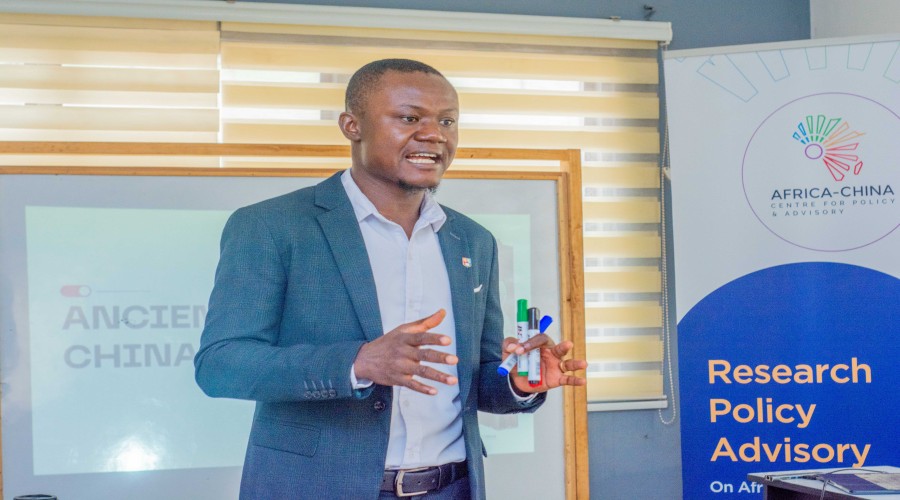
The Executive Director of the Africa–China Centre for Policy & Advisory
(ACCPA), Paul Frimpong, has underscored the critical role of the media in
shaping public understanding of Ghana–China relations and ensuring
accountability in the management of Ghana's international partnerships.
Speaking during the opening session of
the Ghana–China Media Fellowship (GCMF) 2026, Mr. Frimpong emphasized that as
Ghana's engagement with China continues to evolve across trade, investment,
infrastructure, education, and development cooperation, the media has an
increasingly important responsibility to provide accurate, balanced, and
evidence-based information to the public.
According to him, public perceptions of
international partnerships are often shaped by the quality of information
available to citizens. As a result, journalists play a central role in helping
the public understand the opportunities, challenges, and broader implications
of Ghana's engagement with China and other global partners.
“The media plays a critical role in
shaping public understanding of the evolving relations between Ghana and China,
as well as the broader international partnership ecosystem. Citizens rely on
journalists to provide context, explain complex issues, and help them make
sense of developments that affect national development and public policy,” Mr.
Frimpong stated.
He further noted that beyond informing
the public, journalists also serve as an important accountability mechanism
within democratic societies.
“The responsibility of the media does
not end with reporting events. Journalists must be prepared to ask difficult
questions, interrogate policy choices, scrutinize agreements, and hold public
officials accountable for decisions made in the national interest. This is
particularly important in discussions surrounding international partnerships,
including Ghana's engagement with China.”
Mr. Frimpong stressed that informed
public discourse requires rigorous journalism grounded in facts, evidence, and
professional ethics rather than assumptions, misinformation, or sensational
narratives.
He explained that the Ghana–China Media
Fellowship was established to contribute to this objective by strengthening the
capacity of media professionals to report on Ghana–China relations and
international affairs in a balanced, informed, and context-driven manner.
The 2026 fellowship brings together
journalists, media professionals, and content creators from across Ghana for a
twelve-week learning and exchange programme focused on Ghana–China relations,
global affairs, development cooperation, trade, governance, and media practice.
Participants will engage in expert-led
sessions, practical learning activities, collaborative projects, and field
visits designed to deepen their understanding of the issues shaping Ghana's
engagement with China and the wider international community.
The opening session was marked by strong
enthusiasm and engagement from participants, who expressed excitement about the
opportunity to broaden their perspectives, engage with experts, and strengthen
their professional capacity in reporting on international issues.
Source: www.sinoafricainsider.com