By: Nana
Appiah Acquaye
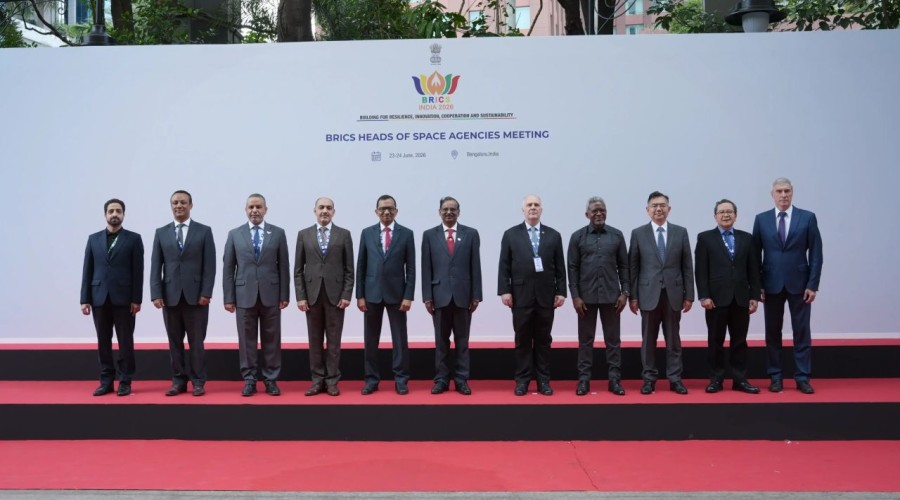
Senior officials and space
agency heads from BRICS member and partner nations have convened in Bengaluru
for high-level discussions focused on sustainable use of outer space, expanded
cooperation in Earth observation systems, and future governance frameworks for
multilateral space collaboration.
The two-day meeting brought
together representatives from Brazil, Egypt, Ethiopia, Indonesia, Iran, Russia,
South Africa, the United Arab Emirates, and China, which was represented by
Chief Engineer Li Guoping of the China National Space Administration, with
India serving as host.
Discussions centered on the
growing need to ensure the sustainable use of Earth’s orbital environment,
including reducing space debris and promoting responsible mission design.
Delegates also emphasized the importance of maintaining peaceful uses of outer
space while expanding cooperation in applying space-based technologies to
address climate change, disaster response, and environmental monitoring.
Participants reviewed
ongoing BRICS space cooperation mechanisms, including the Remote Sensing
Satellite Constellation Cooperation Initiative, which has been operational for
several years and enables participating countries to share Earth observation
data across national space systems. The constellation currently includes
contributions from China, Russia, Brazil, and India.
The meeting also considered
proposals for expanding the initiative to include new participants, including
Indonesia and prospective partner countries such as Saudi Arabia, allowing
broader access to shared satellite data and enhancing collective capabilities
in remote sensing applications.
Another key topic of
discussion was the proposal to establish a BRICS Space Council, an idea
primarily advanced by Russia since 2024. If implemented, the proposed council
would aim to coordinate more complex joint space initiatives and oversee
long-term strategic cooperation among member states. However, officials noted
that views on the proposal remain mixed, with differing levels of support among
participating countries.
Delegates also reflected on
the need to address technical disparities between member states to ensure
equitable participation in space programmes. Capacity-building measures,
including training and technology transfer, were highlighted as potential mechanisms
to strengthen cooperation and enhance collective capability within the bloc.
The Bengaluru meeting builds
on discussions held in Brazil the previous year, where BRICS space stakeholders
emphasized the importance of reducing asymmetries in technological capacity to
support more inclusive collaboration. Subsequent developments included
increased engagement in commercial satellite procurement and expanded interest
in hyperspectral remote sensing capabilities among member states.
While most discussions
focused on multilateral cooperation, some bilateral engagements were also held
on the sidelines of the meeting. According to participants, Russia and India
confirmed that they held separate discussions during the session.