By: Nana
Appiah Acquaye
Technology and digital
policy expert, Ethel Cofie has called on African countries to push for stronger
commitments on financing, cybersecurity, artificial intelligence (AI) and
internet connectivity at the International Telecommunication Union (ITU)
Plenipotentiary Conference 2026 (PP-26), warning that vague policy language
could undermine the continent’s digital development priorities.
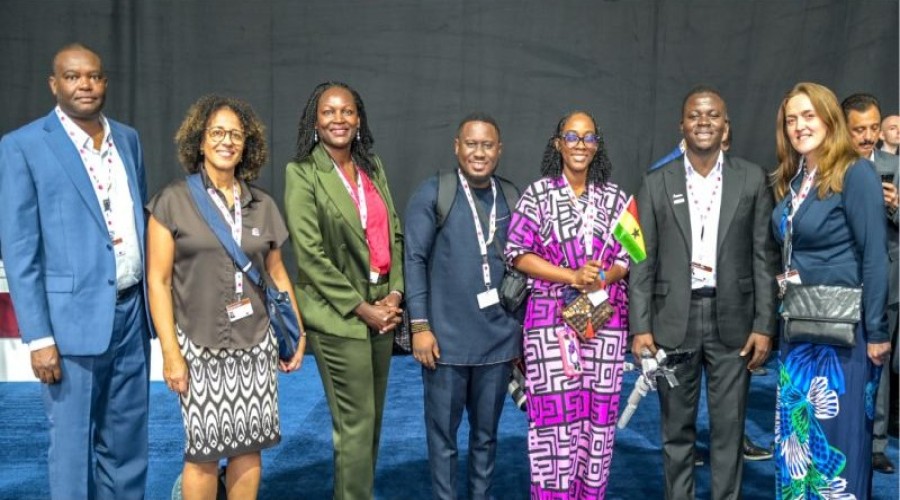
Cofie, who is participating
in the Working Group of the Plenary on Public Policies (WG-PL) in Doha, Qatar,
said the working group plays a critical role in shaping international positions
on AI, cybersecurity, the internet and connectivity, with decisions influencing
how 194 countries develop their national policies over the next four years.
She explained that
negotiations involve detailed discussions over the wording of draft
resolutions, where the difference between terms such as “shall” and “may”, or
“urge” and “invite”, can determine whether commitments translate into concrete
obligations and action.
“‘Shall’ is an obligation.
‘May’ is a suggestion. That one word decides whether money and action follow,
or whether a commitment dies in a filing cabinet,” she said.
Among the issues under
consideration are Resolution 130 on trust and security in information and
communication technologies (ICTs), Resolution 179 on child online protection,
Resolutions 101 and 102 on the internet, and Resolution 139 on connecting the unconnected.
Negotiations are also addressing the role the ITU should play in AI.
Cofie warned that Africa
cannot afford weak or ambiguous commitments, particularly given the continent’s
reliance on digital financial services and its continuing connectivity
challenges.
She noted that about
two-thirds of the world's mobile money value moves through sub-Saharan Africa,
while Ghana alone processes more than a trillion cedis annually through mobile
money transactions.
“When a security resolution
is weak, it is our wallets that get drained,” she said, highlighting the
implications of international cybersecurity decisions for African consumers and
businesses.
On internet connectivity,
Cofie pointed out that Africa has the lowest internet use of any region
globally, arguing that resolutions without clear financing commitments risk
becoming little more than public statements.
“A connectivity resolution
with no financing language is a press release,” she said.
She also stressed that
African countries must actively participate in shaping international AI
governance rather than simply adopting rules developed for other economies.
“AI will be governed with us
or for us. If Africa is not in the drafting, we will spend the next decade
complying with rules written for other economies,” she said.
Cofie acknowledged the role
of the Africa Telecommunication Union (ATU) in bringing common proposals to
Doha but emphasised that African delegates must defend the continent’s
positions during detailed negotiations.
“In plenary, a common
position is a speech. In a working group, it is a negotiation, and it holds
only if African delegates defend the text line by line, late into the night,”
she said.
She outlined the need for
African countries to secure stronger commitments in the final resolutions,
including clear financing provisions, firm language on implementation and
recognition of Africa’s users, data and creators.
For Ghana, which is seeking
re-election to the ITU Council, Cofie said active participation in committee
negotiations was important for building international confidence.
“Countries that do the hard
work in committee are the countries others trust with a seat at the table,” she
said.
Cofie also linked her
participation in the negotiations to her experience in digital infrastructure,
governance and development finance. She serves on the Board of Trustees of
Ghana’s Ghana Investment Fund for Electronic Communications (GIFEC), where she
oversees efforts to connect underserved communities, and on the STAR-Ghana
Governing Council.
Through the Boardroom
Fellowship, she also works to prepare leaders for governance responsibilities.
Reflecting on the importance
of the negotiations, she said the intersection of digital infrastructure,
governance and finance was central to the discussions taking place at PP-26.
“Today that meeting point
has square brackets around it,” she said, referring to the disputed language in
draft resolutions.